
Artificial intelligence (AI) is transforming industries, communication, and creativity. Some AI systems operate with minimal content moderation, giving users unprecedented freedom to learn ideas, generate art, or engage in personalized conversations. These platforms support experimentation, research, and unrestricted content generation, but they also carry ethical, security, and safety risks.
AI adoption grows because businesses use it to improve efficiency, automate tasks, and expand data analysis.
Reports from the McKinsey Global Institute show that over 70% of businesses now integrate AI into operations, reflecting rapid enterprise adoption trends, and major tech companies are projected to invest $300 billion in AI infrastructure by 2025. Industry projections estimate the global AI market could reach $1.8 trillion by 2030, based on aggregated analyses from OECD and global investment reports. The Stanford AI Index Report also highlights accelerating global investment in AI infrastructure and research.
AI now supports applications in medical research, financial forecasting, digital art, and personalized education. These tools unlock productivity and creativity at unprecedented scale. However, as AI becomes more capable, debates intensify over how much freedom such systems should have, and what happens when developers remove moderation safeguards.
Answer First:
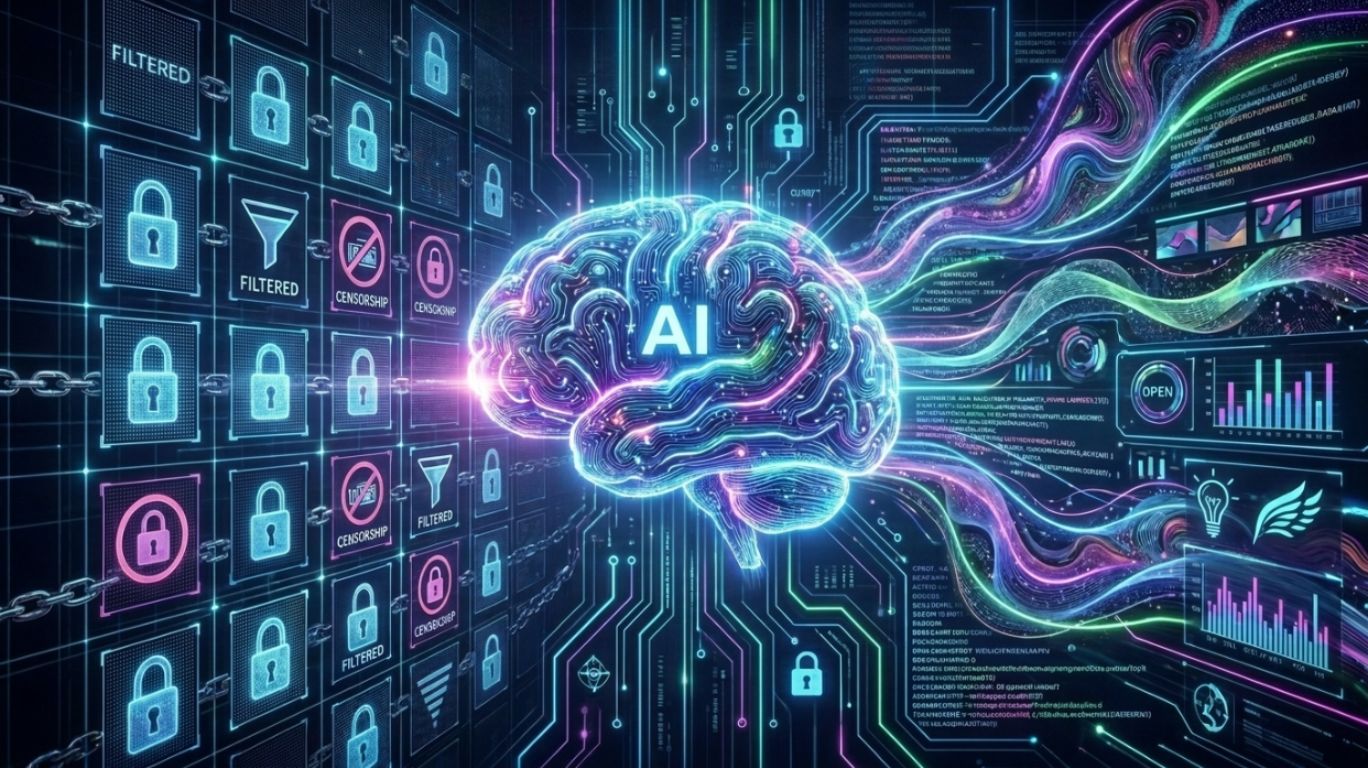
AI uncensored systems generate outputs without strict filters, allowing users to learn any type of content.
Explanation:
Most mainstream AI models have moderation layers to prevent harmful, illegal, or explicit content. These safeguards protect users, comply with regulations, and promote responsible use. Uncensored AI removes these restrictions, giving users complete creative control over text, images, or videos. This can include adult content, roleplay, experimental storytelling, or unrestricted discussions.
NovelAI enables writers to generate long-form, mature storytelling with consistent character memory, while RunDiffusion powers high-performance image generation with fewer content restrictions, supporting advanced creative workflows.
Unrestricted AI improves creative flexibility, supports research, and expands open discussion.
These systems allow broader experimentation than heavily moderated alternatives.
|
Feature |
Moderated AI | Uncensored AI |
|
Content Restrictions |
Blocks harmful, explicit, or illegal content |
Allows broader content generation with fewer restrictions |
|
Creative Freedom |
Limited by platform safeguards |
Greater flexibility for storytelling, art, and roleplay |
|
Research Use |
Restricted in sensitive topic testing |
Useful for studying bias, behavior, and edge cases |
|
Safety Controls |
Built-in moderation and monitoring |
Optional or minimal safeguards |
|
Risk of Harmful Outputs |
Lower due to filtering |
Higher risk of misinformation or harmful content |
|
Privacy Controls |
Often stores and reviews interactions |
May offer greater anonymity depending on platform |
|
Ethical Risk |
Lower platform liability |
Higher misuse potential |
| User Responsibility | Shared between user and platform |
Heavily dependent on user judgment |
Uncensored AI enables creators to push boundaries. Artists, writers, and storytellers can generate content that mainstream platforms would restrict, learning complex characters, controversial themes, or experimental narratives.
For example, Stable Diffusion delivers open-source image generation that allows users to fine-tune models and produce unrestricted visual storytelling across highly customized styles. Writers can use NovelAI to study mature storylines or alternative historical fiction without moderation blocking key content.
Researchers studying AI behavior, bias, or ethics benefit from unrestricted systems. Access to uncensored outputs provides insight into how AI models process sensitive topics, handle prompts, and generate diverse content. This research informs safer model development and better AI transparency.
Universities and independent AI labs may leverage uncensored models to stress-test AI safeguards or measure how AI interprets complex instructions, a process not possible with fully moderated systems.
Some users value uncensored AI for open dialogue. It allows conversations about sensitive, controversial, or taboo subjects in controlled environments. While moderation prevents harm, uncensored AI provides a space for informed, responsible experience. For instance, roleplayers or educators may discuss historically sensitive scenarios or generate educational content about complex social issues.
Answer First:
AI uncensored introduces ethical, security, and social risks.
Explanation:
AI platforms can balance creative freedom with ethical safeguards. Best practices include:
Girlfriend.ai integrates conversational AI with adjustable moderation settings, allowing users to balance open dialogue with controlled safety filters in real time.
Uncensored AI works by reducing moderation layers while preserving core model capabilities.
Developers adjust prompts, fine-tune outputs, and apply optional safeguards.
These technical strategies reduce misuse while preserving system flexibility. Researchers and creators can study its full potential while minimizing risk.
Developers will build hybrid AI systems that combine flexible output controls with stronger safety tools.
Future systems will likely offer adjustable moderation and stronger privacy protections.
Uncensored AI is not inherently unsafe. Its impact depends on platform design, informed use, and ethical safeguards. The most effective AI platforms will balance creative potential with responsible implementation, empowering users without introducing significant risks.

Users also share responsibility. Best practices include:
By combining platform safeguards with user responsibility, uncensored AI can be a tool for innovation rather than a source of harm.
AI uncensored represents both opportunity and responsibility. When used ethically, it enables creativity, research, and open discussion. By prioritizing user control, transparency, and informed usage, society can harness uncensored AI to expand imagination, knowledge, and innovation safely. Understand responsible uncensored AI at girlfriend.ai for safe, flexible, and creative experiences.
AI uncensored refers to systems without strict content moderation, enabling unrestricted generation of text, images, or video. While it increases creativity, it also raises the risk of producing harmful or misleading content.
Creators, writers, and roleplayers often need platforms without limits to experience mature themes, complex narratives, or sensitive topics. Researchers also use uncensored systems to study AI behavior and improve future models.
They can be, depending on usage. Without safeguards, uncensored AI may generate harmful, misleading, or illegal content. Responsible platforms and informed use are essential to mitigate these risks.
Yes. Platforms that incorporate consent-based features, transparent data use, and adjustable moderation provide a safer environment for creative and research purposes. Users must remain informed and cautious.