
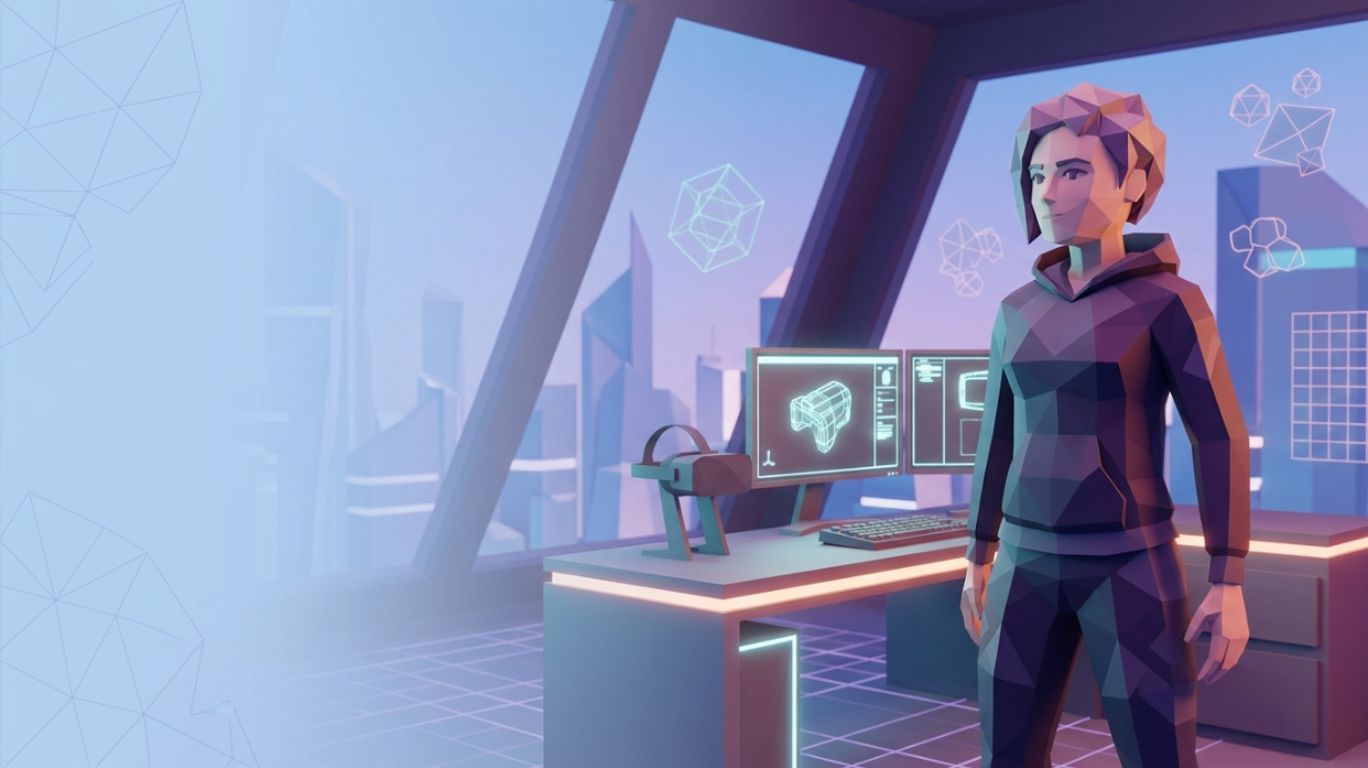
Low-poly characters have become a beloved art style across the 3D design world, from game developers and animators to digital artists and VR creators. What started as a technical necessity in early 3D graphics has developed into a stylistic choice that blends simplicity with creativity. Whether developing a video game, experimenting in Blender, or crafting an immersive VR world, low-poly characters are a perfect way to balance performance and aesthetics.
A low-poly character is a 3D model built with fewer polygons to improve rendering speed and simplify design. Artists use low-poly modeling to create clean, efficient character assets for games, animation, and virtual environments, as documented by Wikipedia.
Low-poly design originated during the early days of video games, when hardware limitations made high-detail graphics impossible. Developers had to work within strict performance constraints, so they created characters with simple geometry and sharp, clean lines. Over time, this look became iconic and is now embraced for its minimalist beauty and efficiency.
Today, the low-poly aesthetic is used not just for retro-style games but also for mobile apps, animation, and even digital sculptures. Its charm lies in distilling complex forms into clear, readable shapes without sacrificing personality or style.
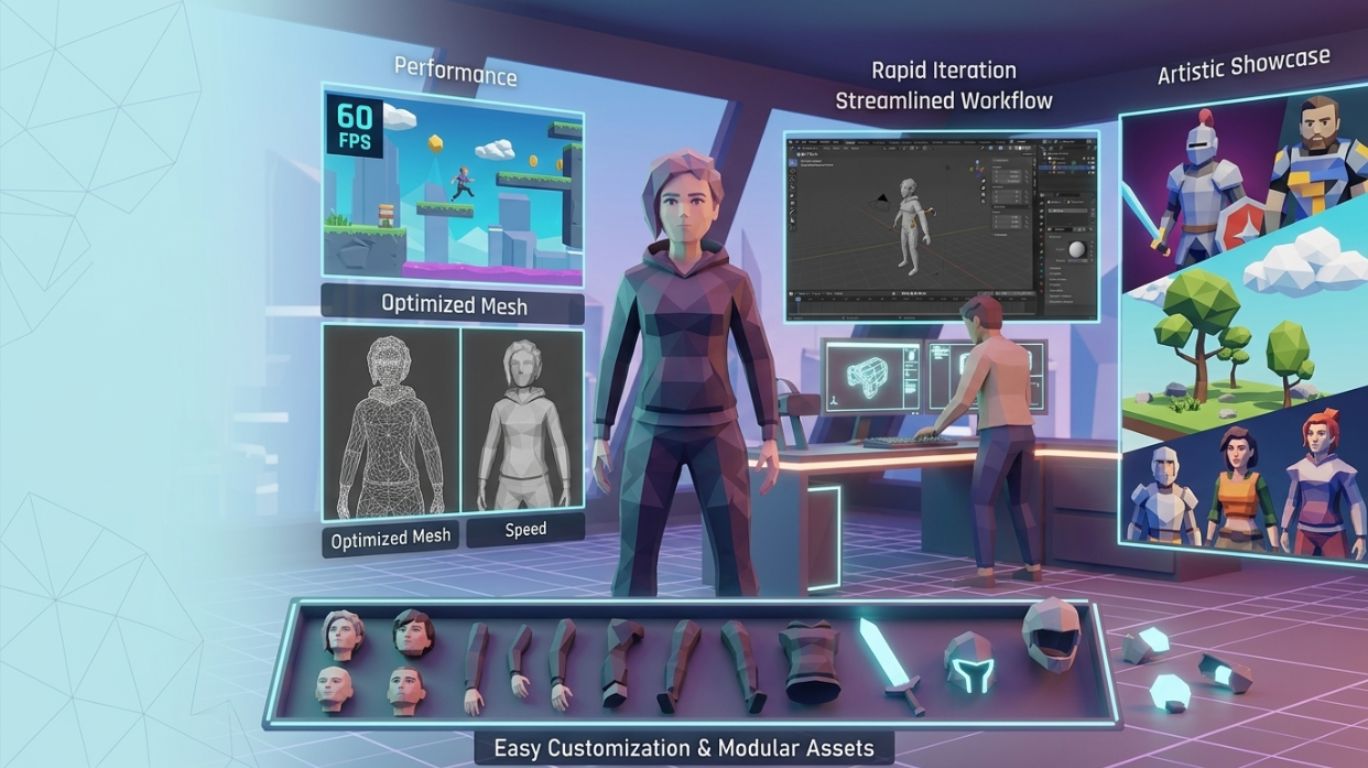
The appeal of low-poly design goes beyond nostalgia. Here are some of the main reasons artists and developers still rely on low-poly characters today:
Low-poly models reduce rendering load and improve frame rates in real-time environments. Unity Technologies documents recommend optimized mesh structures to maintain stable performance in game development.
Creating high-resolution characters can be time-consuming and resource-heavy. Low-poly modeling speeds up the process, allowing teams to build detailed worlds without overloading their pipeline. It’s beneficial for indie developers and small studios.
The aesthetic of low-poly art is instantly recognizable. Its sharp edges, bold shapes, and geometric charm lend a unique, modern look that resonates with players and audiences alike. Many creators choose this style deliberately to stand out in a world full of hyper-realistic visuals.
Low-poly models are flexible and easy to modify. With simple geometry, creators can quickly adjust proportions, colors, or animations to match artistic visions or gameplay requirements.
Finding high-quality, low-poly characters has never been easier. Developers can find low-poly assets in marketplaces and open repositories that offer standard formats such as OBJ, FBX, and GLTF, making integration easier across major 3D platforms.
Some websites also offer affordable premium models with higher quality textures or more complex animations, perfect if you want to expand beyond the free resources.
|
Platform |
Primary Use | Supported Formats | Best For |
|
Blender |
Modeling, rigging, animation | OBJ, FBX, GLTF |
Beginners and independent creators |
|
Unity |
Game development | FBX, OBJ, GLTF |
Mobile and indie game projects |
|
Unreal Engine |
Real-time rendering and games | FBX, GLTF |
High-performance game environments |
|
Godot |
Lightweight game development | GLTF, OBJ |
Open-source game workflows |
| Autodesk Maya | Professional 3D production | FBX, OBJ |
Studio production pipelines |
Making your own low-poly characters can be an enriching experience if you’re feeling creative. Here are a few beginner-friendly tips to get started:
Begin with basic shapes like cubes, spheres, and cylinders. The key to low-poly design focuses on silhouette and proportion rather than intricate detail.
Clean topology improves deformation during rigging and animation. Blender Foundation documentation explains how edge flow affects movement and mesh stability.
Even simple models benefit from having a reference. Study anatomy, poses, or real-world objects to make your designs more believable and expressive.
Since textures are minimal, color becomes an essential part of your design. Use flat or gradient tones to give your character visual depth without relying on heavy materials.
If your goal is real-time performance, always test your model within the target environment. Could you make sure it runs smoothly and looks good from multiple angles?
Despite technological advances that allow hyper-realistic rendering, low-poly art continues to thrive. Its timeless appeal lies in the balance it strikes between creativity and practicality. From indie games to commercial animations, the style allows artists to focus on storytelling, atmosphere, and design rather than chasing photorealism.
The low-poly movement will likely expand further as more creators adopt tools like Blender and Unreal Engine. With the growing accessibility of free and affordable assets, the barrier to entry for 3D design has never been lower.
Low-poly characters are more than just simplified 3D models, they represent an artistic philosophy. They celebrate minimalism, creativity, and efficiency all at once. Whether you’re a hobbyist learning 3D modeling or a developer building your next big project, learning low-poly design can spark fresh inspiration and endless creative possibilities.
Learn more 3D modeling guides, Blender tutorials, and game asset optimization strategies.
A 3D model is considered low-poly when it uses a relatively small number of polygons to define its shape. This results in a model that looks simpler but renders faster and performs more efficiently. Low-poly models typically have clean edges and visible geometric facets, giving them a distinct, angular style.
There’s no fixed number, but most low-poly characters are between 300 and 3,000 polygons, depending on the level of detail needed. The goal for mobile games or VR projects is to keep the polygon count as low as possible while maintaining recognizable forms and smooth animations.
While low-poly characters aren’t designed for photorealism, they can still be expressive and detailed through clever design, textures, and lighting. Many modern games combine low-poly modeling with high-quality shading to create visually rich environments that balance realism and stylization.
Popular 3D software like Blender, Maya, and 3DS Max are excellent for creating low-poly characters. Blender is especially favored for its accessibility and powerful modeling tools, making it an excellent choice for beginners and professionals.
Blender remains a common choice because Blender provides polygon editing, sculpting, UV mapping, and rigging tools in one workflow.
Because of their simple geometry, low-poly characters are often easier to rig and animate. Fewer polygons mean less computational load, making animation playback smoother and rendering faster, especially useful in game development and virtual production.