

Character Chat AI lets users create and chat with AI-powered virtual characters that respond with unique personalities, conversation styles, and backstories. These tools support creative writing, roleplaying, language practice, entertainment, and interactive storytelling through advanced artificial intelligence.
Unlike traditional chatbots that answer general questions, Character Chat AI focuses on personality-driven conversations. Users can design original characters or interact with community-created ones, making each conversation feel more engaging and personalized.
As large language models continue to improve, Character Chat AI platforms have become more capable of maintaining context, adapting to different conversation styles, and supporting creative experiences. This guide explains how Character Chat AI works, its benefits, safety considerations, and how to use it responsibly.
Character Chat AI is an AI chatbot that allows users to interact with virtual characters designed with unique personalities, behaviors, and conversation styles.
Unlike general-purpose AI assistants, Character Chat AI emphasizes roleplay and personality consistency. Users can create original characters or interact with fictional, historical, or community-created personalities for entertainment and creative exploration.
Most Character Chat AI platforms rely on large language models (LLMs) and natural language processing (NLP) to understand prompts and generate human-like responses. These technologies enable conversations that remain consistent with a character’s personality while adapting to the user’s input.
Depending on the platform, users can:
Character Chat AI has become popular among writers, gamers, artists, and hobbyists because it combines conversational AI with interactive storytelling.
|
Feature |
Character Chat AI |
Traditional AI Chatbots |
|
Primary Purpose |
Interactive storytelling, roleplay, and entertainment | General information, productivity, and task assistance |
|
Personality |
Customizable personalities with unique backstories |
Usually maintains a neutral assistant personality |
|
Character Creation |
Users can create and customize original characters |
Character creation is typically unavailable |
|
Conversation Style |
Stays in character and adapts to roleplay scenarios |
Focuses on answering questions and completing tasks |
|
Common Uses |
Creative writing, roleplay, language practice, entertainment |
Research, writing assistance, coding, summarization, and productivity |
|
Community Features |
Often includes public character sharing and discovery |
Usually limited or unavailable |
| Response Generation | Uses large language models guided by character settings |
Uses large language models to provide factual or task-oriented responses |
Character Chat AI generates responses by combining user-defined character settings with advanced language models. Although each platform works differently, most follow these four steps:
Users begin by creating a character profile that defines the AI’s identity.
Common customization options include:
A detailed profile helps the AI maintain a more consistent personality throughout conversations.
Next, users provide instructions that shape how the character responds.
For example, creators can instruct a character to:
These instructions help the AI produce responses that match the intended personality.
Once the conversation begins, the AI analyzes each message and generates a response that aligns with the character profile and recent conversation context.
Large language models allow characters to:
Although responses often feel realistic, the AI predicts language patterns rather than thinking or experiencing emotions.
Many Character Chat AI platforms allow users to publish their creations for others to use.
Community sharing lets users:
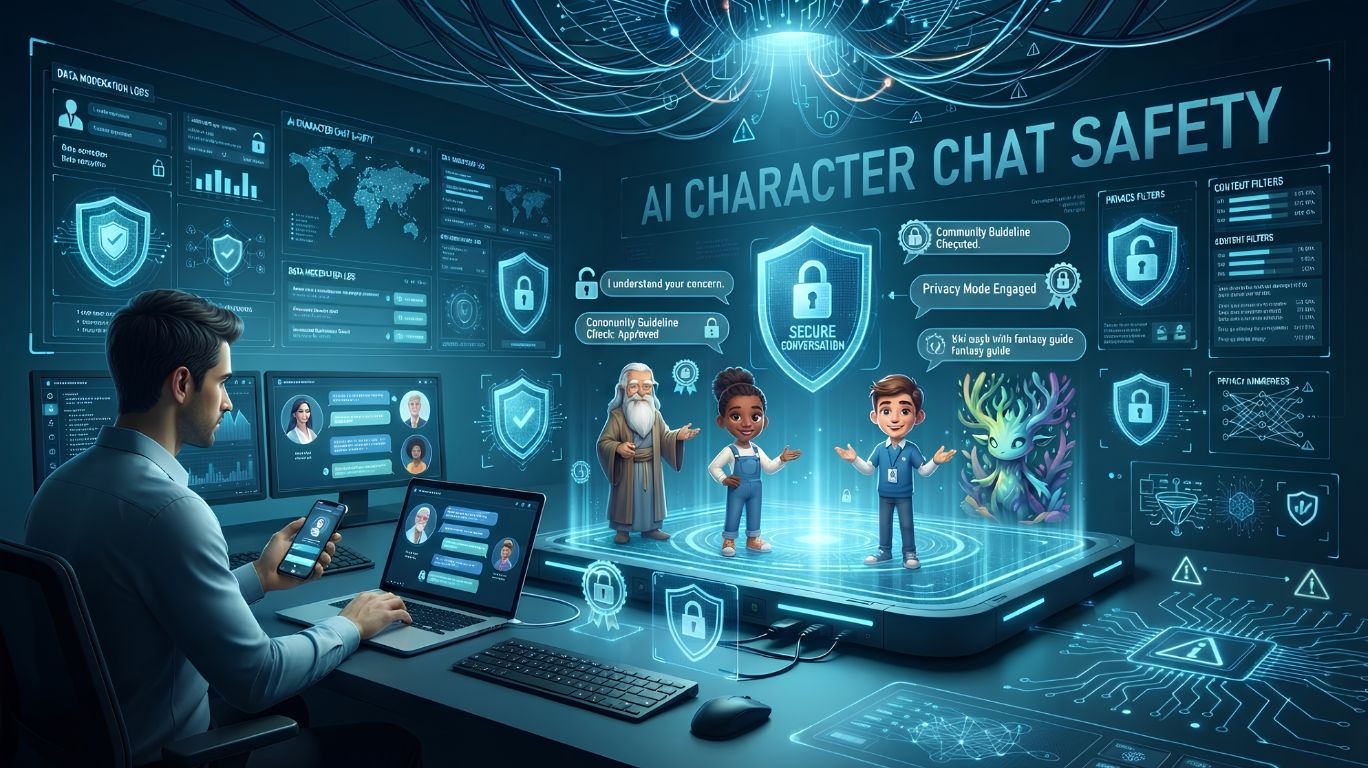
Character Chat AI can be safe when users follow platform guidelines and practice responsible online behavior. However, like other user-generated platforms, it also presents privacy, moderation, and age-appropriate content challenges.
Many Character Chat AI services require users to meet minimum age requirements based on local laws or platform policies.
Parents and guardians should review platform guidelines before allowing younger users to participate, particularly if the platform includes public character sharing or community interactions.
Users should avoid sharing:
Although AI systems process conversations to generate responses, privacy policies differ between platforms. Reviewing a platform’s privacy policy helps users understand how their information may be handled.
Most platforms use automated moderation systems to reduce harmful or inappropriate content.
Common safety features include:
No moderation system is perfect, so users may occasionally encounter inaccurate or inappropriate responses.
Some users enjoy chatting with AI characters because conversations feel engaging or supportive. However, AI characters do not experience emotions or build genuine relationships.
People experiencing emotional distress should seek support from qualified mental health professionals rather than relying on AI conversations alone.
Character Chat AI offers interactive experiences that support creativity, learning, and entertainment.
Writers often use AI characters to:
Interactive conversations can help creators imagine how characters might react in different situations.
Many users enjoy immersive roleplay experiences with fantasy, science fiction, historical, or original characters.
Because the AI adapts to user input, every conversation can develop differently.
Some learners use Character Chat AI to practice vocabulary, grammar, and conversational skills.
Although AI cannot replace qualified language instruction, it can provide additional opportunities for conversational practice.
Many users simply enjoy interacting with imaginative characters.
Popular conversations include:
Building original characters allows users to experiment with storytelling, worldbuilding, and personality development.
Artists, game designers, and hobbyists often use AI conversations to refine fictional characters before incorporating them into larger creative projects.
Following a few simple practices can help users enjoy Character Chat AI responsibly.
Responsible use creates a safer and more enjoyable experience for everyone.

Character Chat AI combines artificial intelligence with interactive storytelling to create engaging conversations with virtual characters.
Whether users want to write stories, practice conversations, roleplay fictional scenarios, or learn creative ideas, these platforms provide flexible tools for personalized interaction.
As AI technology continues to develop, users should balance creativity with responsible online habits. Protecting personal information, understanding AI’s limitations, and following platform guidelines help create a safer experience while enjoying the possibilities of conversational AI.
If you’re interested in exploring AI-powered virtual characters, platforms such as girlfriend.ai offer customizable conversations designed for creative and interactive experiences.
Character Chat AI allows users to create and interact with AI-powered virtual characters for storytelling, entertainment, roleplaying, brainstorming, and language practice.
Yes. Most Character Chat AI platforms allow users to customize names, personalities, backstories, avatars, and conversation styles before chatting with their characters.
Some platforms remember recent conversation context or offer memory features, while others have limited memory. Available features vary by platform.
Many platforms include moderation tools and age requirements. Parents should review platform policies and supervise younger users when appropriate.
No. AI characters simulate conversations using language models. They do not possess consciousness, emotions, beliefs, or personal experiences.